

I’m French, and I’ve been a wedding DJ near Toulouse since 2004. I also spent seven years running my own DJ business in Canada before coming back. That’s not the same as growing up going to weddings on both sides, but it means I’ve stood behind the decks for both formats enough times to know exactly where they pull apart.
If you’re planning a wedding in France and your only reference point is what you’ve been to at home, this is the part nobody hands you before you sign a venue contract. Here’s the short version first, then the detail on each line below.
| Your wedding | A French wedding | |
|---|---|---|
| The night before | Rehearsal dinner, often with a run-through and a meal for the wedding party and close family | No real equivalent, nothing formalised |
| Ceremony | Mid-afternoon, personal vows, one script | Civil ceremony at the town hall, often in the morning, sometimes a separate religious or symbolic ceremony later |
| Cocktail hour | About an hour, during photos | Two to three hours, often more guests than at dinner |
| Grand entrance | Wedding party announced by name, then the couple | Couple walks in, no individual announcements |
| First dance | Early, right after the entrance or right after dinner | Around midnight, after dessert |
| Dinner | Seated, about two hours | Seated, three to four hours |
| Toasts | Structured: best man, maid of honor, father of the bride, mic managed by the DJ | Open floor, several people, no set running order |
| Expected moments | Parent dances, cake cutting, bouquet and garter toss, last dance, sometimes a sparkler send-off | Pièce montée as a staged moment, party games |
| End time | 22:00 or 23:00, a hard cut-off set by the venue | 2am to 4am, dance floor open late |
None of this is better or worse, it’s just different, and it’s exactly what I plan around. The rest of this page goes line by line, with the why and what to do about it.
The night before: rehearsal dinner vs nothing
In the UK, US, Canada and Australia, the night before is often its own event: a run-through of the ceremony, then a dinner with the wedding party, close family, and anyone who’s travelled a long way. It’s expected, and venues plan around it.
France has no real equivalent. There’s no cultural slot for it, so if you want one, you’re building it from scratch, not slotting it into a template your venue already knows how to run. Tell your venue early. Some will host it without blinking, others have simply never been asked.
The ceremony: afternoon and personal vs morning and administrative
Your ceremony is likely mid-afternoon: a processional, an officiant or celebrant, personal vows you wrote yourselves, a recessional. One event, one script, done by everyone who’s ever been to a wedding back home.
In France, the only ceremony with legal weight is the civil one at the town hall, the mairie, often in the morning and sometimes on a different day entirely. Couples who want a religious or symbolic ceremony add it separately, sometimes hours later, sometimes the day after. If your venue mentions “the ceremony” without specifying which one, ask. It matters for your day-of timeline and for your photographer’s schedule.
Cocktail hour vs vin d’honneur
Your cocktail hour runs about an hour, usually while the wedding party finishes photos. It’s a holding pattern before the main event.
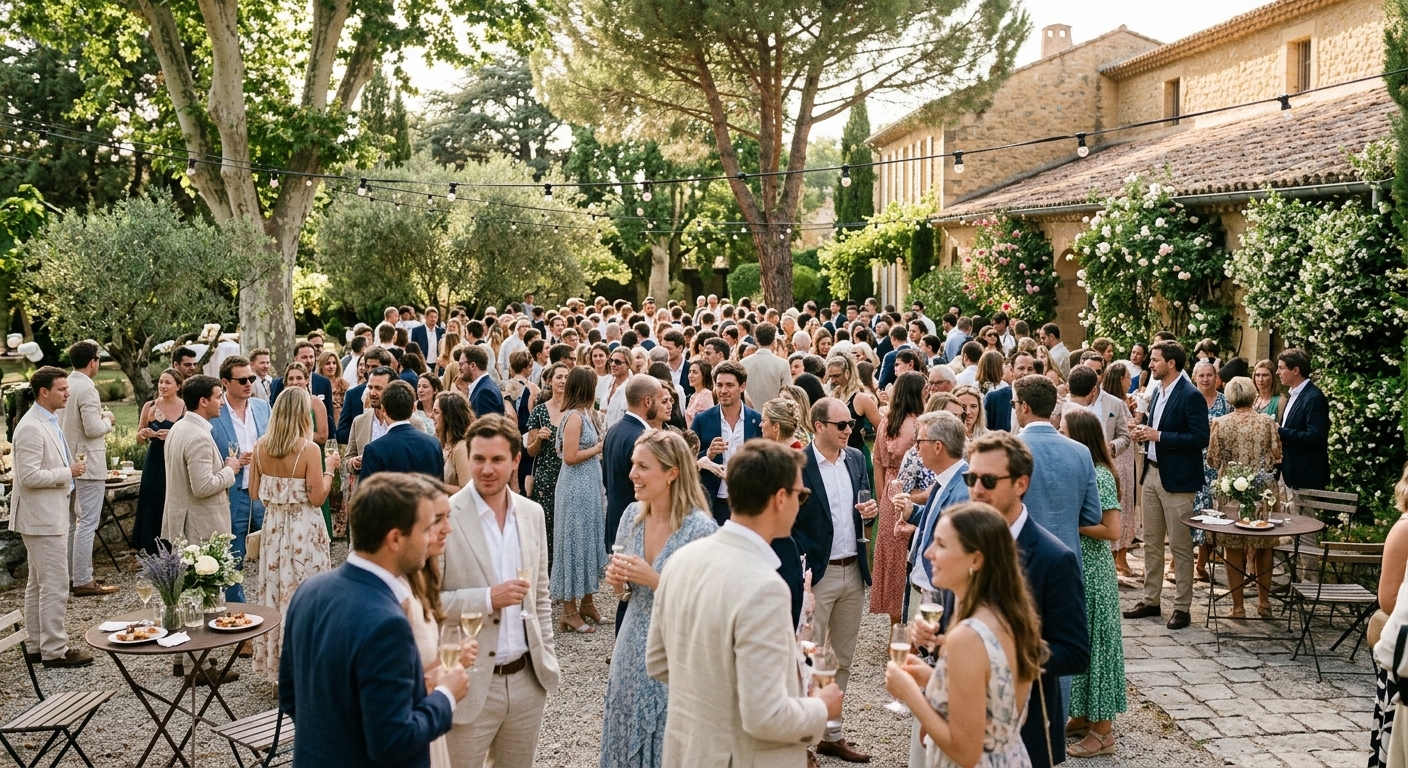
The French vin d’honneur is the main event, or close to it. Two to three hours, often with more guests invited to this part than to the seated dinner that follows. Extended family, neighbours, colleagues, people who wouldn’t get a dinner seat but absolutely get a glass of something and a slice of the toast. If your numbers feel odd on the venue’s guest sheet, this is usually why.
Grand entrance vs simply walking in
The grand entrance, wedding party announced by name one couple at a time, then the newlyweds, is a fixture where you’re from. It’s a moment, it’s expected, and the DJ runs it.
In France it doesn’t really exist as a format. The couple walks in, guests applaud, that’s it. If you want your entrance, you’ll need to ask for it specifically and build the moment rather than assume the room already knows the cue.
First dance: early vs after midnight
Your first dance tends to land early, right after the entrance, or right after dinner at the latest. It’s often the emotional high point of the evening’s first half.
In France, first dance (“ouverture de bal”) is a much later marker, typically after dessert, which itself doesn’t arrive until close to midnight given how long the seated dinner runs. If a French venue or planner tells you dancing starts “late,” they mean it more literally than you might expect.

Dinner length
Seated dinner at home runs about two hours: starter, main, speeches woven in, done.
A French wedding dinner runs three to four hours, multiple courses, and it’s treated as its own extended chapter of the evening rather than a prelude to the party. Guests don’t expect to be up and dancing by nine.
Toasts: structured vs open floor
Best man, maid of honor, father of the bride: your toasts follow a known running order, and the DJ or MC manages the microphone and the timing.
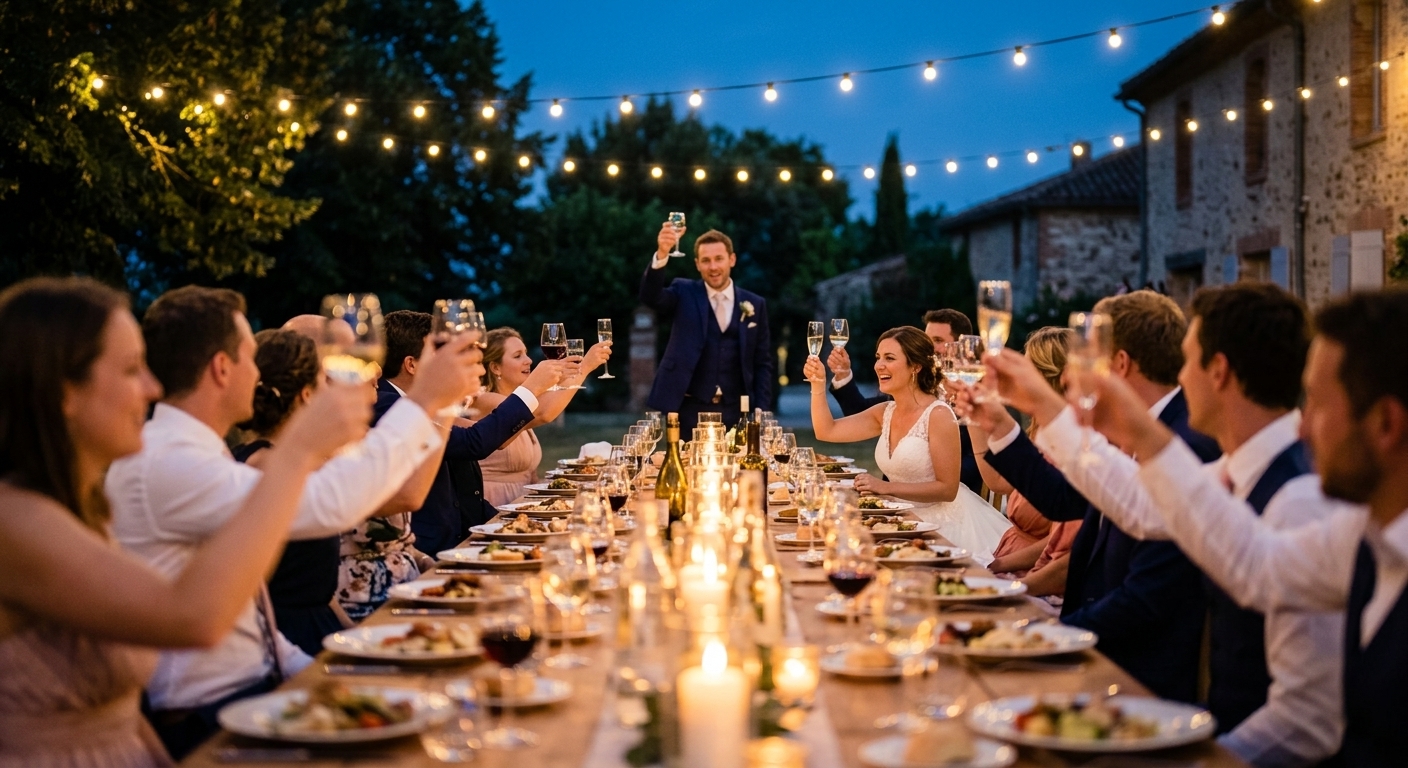
French toasts are looser. Several people might want to speak, nobody’s necessarily assigned the role in advance, and there isn’t a cultural script for who goes when. If a tight toast schedule matters to you, it needs to be planned deliberately, it won’t happen by local custom.
The moments guests expect
Parent dances, cake cutting as a distinct moment, bouquet and garter toss, a last dance, sometimes a sparkler send-off: these are load-bearing traditions at a wedding from home. Guests notice if they’re missing.
French receptions have their own fixtures instead: the pièce montée (a croquembouche-style dessert tower) arrives as a staged moment, not just dessert service, and the evening often includes party games organised by friends or witnesses. If you want your traditions kept, say so explicitly. Nobody local will suggest a garter toss unprompted, it’s simply not part of the format here.
What time does it end
A hard cut-off, 22:00 or 23:00, set by the venue’s noise agreement with its neighbours or municipality, is normal at home.
French venues often run until 2am, sometimes later, and the whole evening is built around that longer runway: dinner starting at eight, dessert at midnight, dancing picking up after that. It’s also worth knowing that a lot of French venues run sound limiters, devices that cut power to the sound system if the room goes over a set noise level. It measures the whole room, guests included, not just the speakers. It catches people off guard mid-dance far more often than it should, given how common it is.
One thing that surprises couples more than any of the above
At home, your DJ is often your MC too: welcoming the room, calling the toasts, announcing the entrance, running the whole show on the microphone. In France, that’s not the default. The DJ’s role here has historically been musical first. If you want a strong MC presence, it has to be arranged deliberately, either with your DJ directly or by briefing whoever’s taking the mic for toasts, rather than assumed as part of the package.
If you’re planning a wedding in South-West France and want someone who already knows where these two formats pull apart, see how I work with English-speaking couples or message me directly.